Browser flight sim · no install

Rocket
Catch

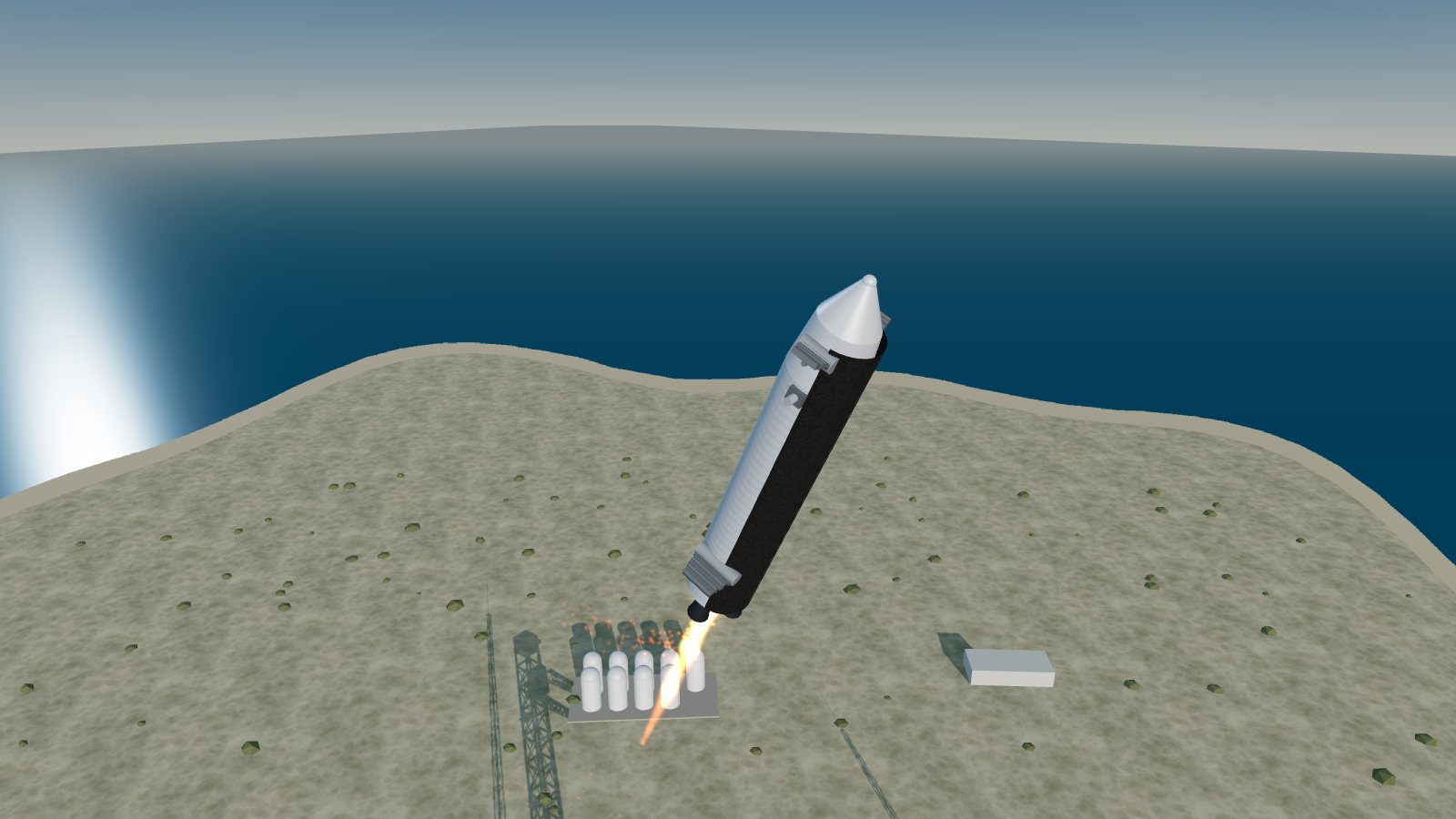
Seventy metres of empty steel falls out of the sky at 85 m/s. You have one landing burn to thread it between two arms, inside four tolerances at once.

Why this exists

Flight 15 was meant to be the first time both stages came back to the tower. The upper stage made it — caught out of the sky, which nobody had ever done. The booster never got its attempt: with not every parameter nominal, the call was made to put it in the water instead.

On video the catch looks almost unhurried. The vehicle slides into frame, the arms close, it hangs there. Nothing about the footage tells you what it cost to make that look easy, and that is exactly the problem — a thing done well looks like a thing that was never hard.

So fly it yourself. The numbers here are the real ones: a fixed physics step, thrust that only steers while the engines are lit, a booster that cannot hover on all its engines, and four tolerances that must be satisfied at the same instant, in the last second, after which there is no second attempt.

You will put a lot of steel into the ground. That is not the game being unfair; it is the manoeuvre being hard. The built-in autopilot flies a profile tuned to the fuel optimum and still misses roughly one in three booster landings.

When you have wrecked twenty of them, go back and watch the real footage again. It should look different. That is the whole point of this — not to simulate a rocket, but to earn the right to be impressed by one.

Flight 15 is the flight this is built around — Booster 22 and Ship 42. One catch made, one declined. That second decision is worth as much as the first: the margins are narrow enough that the correct answer, with the vehicle already on its way down, was not to try. The game lets you take either seat — including the attempt nobody actually made.

Four gates, all at once

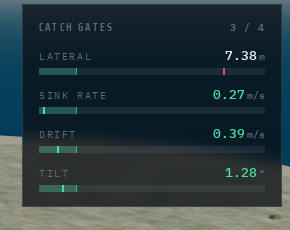
The tower does not slow the vehicle down — it only holds what arrives correctly. The catch pins have to cross the arm plane inside every limit simultaneously. Miss one and you are scrap.

1.50 mLateral offset
2.00 m/sSink rate
0.80 m/sDrift
2.00°Tilt

The instrument that matters

Each gate is a live needle in a tolerance band. You do not fly the rocket by looking at the rocket — you fly it by walking four needles into their gates and keeping them there through the last second.

A plan view shows your lateral offset against the arms, your velocity vector, and which way the vehicle is actually leaning.

The catch gates panel: lateral, sink rate, drift and tilt, each a needle inside a green tolerance band.

Two vehicles, two problems

They are not the same craft at different sizes. Each fails in its own way, and the skill that saves one will not save the other.

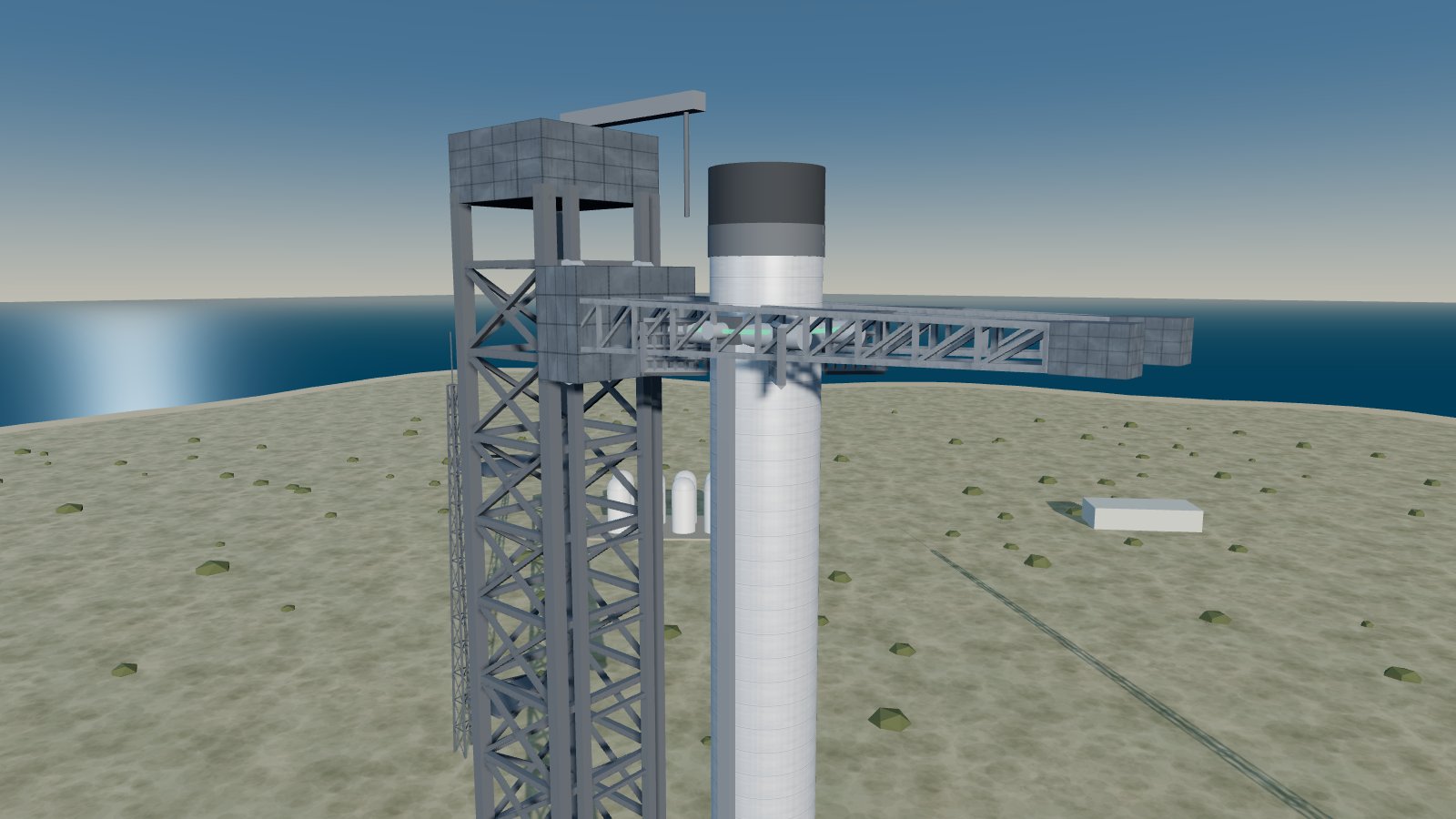
The booster hanging from the closed chopstick arms after a successful catch.

Super Heavy

Comes down cold and accelerating. The gimbal only bites while the engines are lit, so with them out you have no attitude authority at all beyond five seconds of cold gas.

Light the burn too late and you arrive as a crater. Too early and you climb away from the tower with nothing left in the tanks.

200 t dry · 16 t landing propellant
3 of 33 Raptors · TWR 3.4 at full
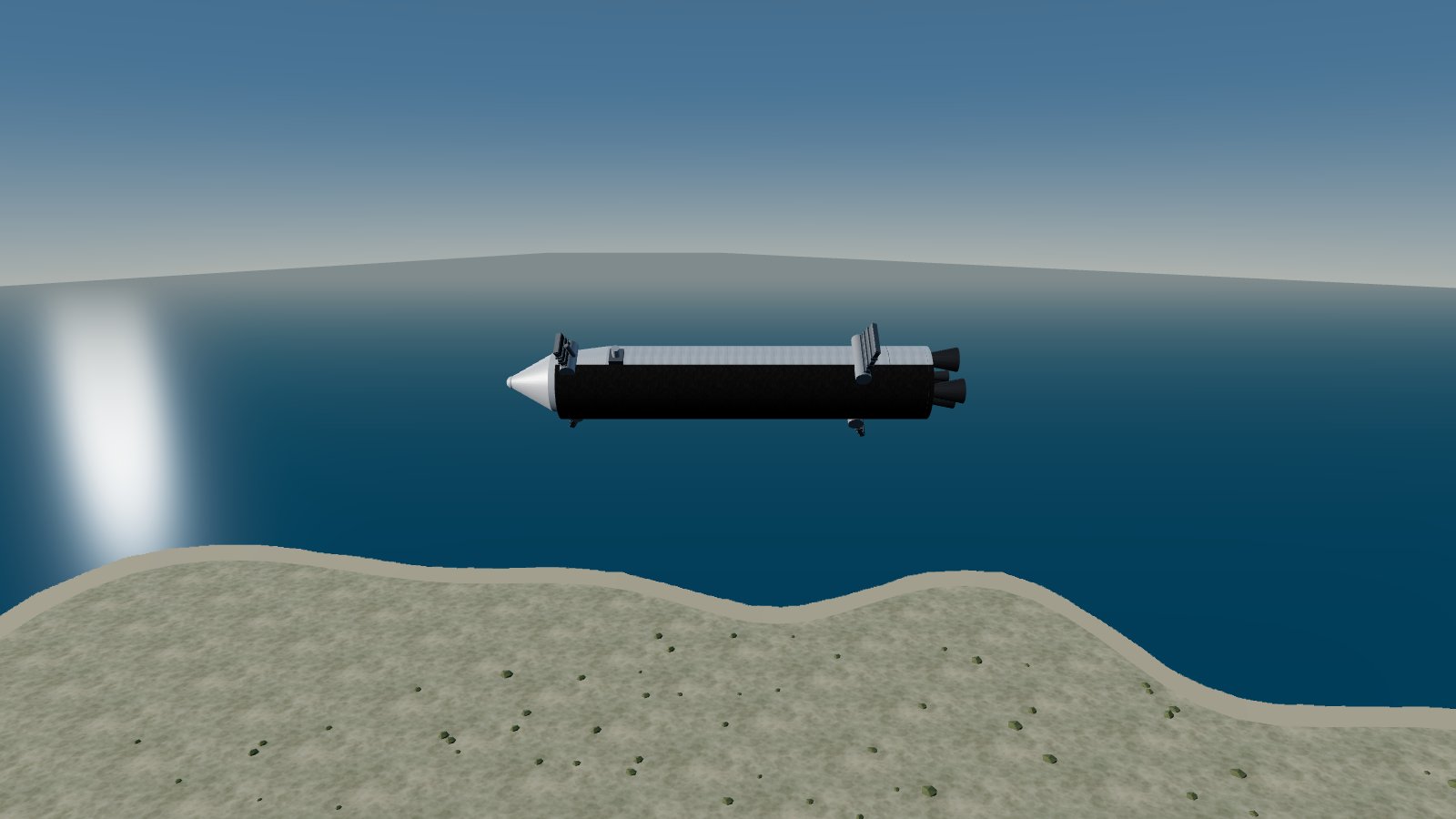
The ship falling belly-first, flaps deployed, heat shield into the airflow.

Ship

Comes home belly-first at about 87 m/s with the engines cold, steering on four flaps. Around seven hundred metres you commit to the flip — one automated manoeuvre, no taking it back.

A single sea-level Raptor leaves under 1 g of margin. Go late and nothing you do will arrest 87 m/s before the arms.

110 t dry · 9 t header tanks
1 sea-level Raptor · TWR 2.0 at full

Flying it

Steering is relative to the camera, not to the world — W always pushes the vehicle away from you, whichever view you are in. On a phone or tablet the same controls appear as a thumb stick and a throttle slider.

KeyDoes
WASDSteer, relative to the view
QEThrottle down / up
SpaceIgnite or cut — commits the flip on the ship
ShiftCold gas, snaps you level (about five seconds of it)
CCycle camera: tower, chase, pad
PHand over to the autopilot, mid-flight if you like
RAbort and retry

Watch it fly first

There is an autopilot, and it exists to prove the thing is landable. It drives the same keys you do and shows what it is pressing and why — sink rate commanded against actual, where it is steering, how far to the flip.

It catches roughly two thirds of the time. That is not a target to match; it has perfect state knowledge and reacts every physics tick. Treat it as proof the envelope is real.

Open the sim

How to land it

Both vehicles reward the same thing: deciding early and committing. Here is what actually works, which is not always what feels safe.

Super Heavy

  1. Do not wait for the perfect moment. A late full-throttle burn is fuel-optimal but buys you only about six seconds of control authority. Lighting early and holding a steady deceleration buys fifteen.
  2. Kill the crossrange high. The gimbal only works under thrust, and leaning costs you tilt you must pay back before the arms.
  3. Settle, do not slam. Shutting engines down lets you throttle below your own weight: about 30% holds a hover, the floor at 22% settles you gently. Every second of hovering is propellant you will want back.

Ship

  1. Use the flop to aim. The flaps steer where you point, the engines stay cold, and drag caps you at about 87 m/s. This is the cheap part of the descent — spend it.
  2. Flip near seven hundred metres. The usable window runs roughly 700 to 1100 m, about four and a half seconds wide. Watch the altimeter, not the ship.
  3. Then fly it down. One Raptor can hover, so the descent forgives you — the flip does not. Late is unrecoverable; early drains the header tanks.
The ship mid-flip, rotating from belly-down to vertical with its engine lighting.
Committed. The flip is automated once you call it — your only decision was when.
A booster exploding on the flats beside the tower after a missed catch.
The other outcome. The fireball opens as a column the shape of whatever just died.

It is a real flight model

Nothing here is faked with an animation curve. The vehicle is integrated at a fixed 1/180 s step and every number below came from a published figure or was solved for until it reproduced one.

Thrust and mass

Raptors at 2.3 MN with a 40% per-engine floor. The booster throttles below its own weight the way the real one does — by shutting engines down, not by throttling three of them into the ground.

The gimbal is torque

Steering does not shove the vehicle sideways. It deflects the engines, which makes a moment, which tips the stack, which points the thrust. That lag is the whole difficulty.

Solved, not guessed

The ship's drag areas were back-solved until the belly flop settled at 87 m/s — inside the published range. The flip altitude then fell out at 760 m on its own, close to SpaceX's stated optimum.

Masses and drag areas for the ship are estimates — SpaceX has not published them. Everything else follows from figures that are public.

What a thousand means

Every catch is scored out of 1000. More than half of it is propellant, which is the part most people leave on the table.

550 points · propellant

What is still in the tanks when the pins settle. This is not measured against the tank you started with. Arresting a 900 m fall costs the booster about 68% of its load however well you fly, so scoring against capacity would have capped a flawless flight at 628 and left the top third of the scale permanently dead. It is measured against the best a vehicle can physically do instead.

450 points · precision

How far inside the four gates you arrive. Each one scores full marks at zero and nothing at the limit, so being merely legal is worth little. Arriving at the 2.00 m/s sink limit rather than a dead stop saves you around 120 kg of propellant and costs you 112 points — never trade precision for fuel.

A perfect 1000 is a real target, not a fiction: dead centre, no sink, no drift, no tilt, and the fuel-optimal burn. That burn is the greedy one — fall with the engines cold as long as your nerve holds, then go to full throttle and arrive at walking pace. On paper the booster's optimum lights at 442 m already doing 127 m/s, and the ship's last survivable flip is just under 700 m. Both of those assume you never spend a gram correcting sideways, so treat them as the wall rather than the plan: fly a little earlier than the theoretical latest and keep something back for the drift. Light earlier still and you hover away your margin; light later and there is no later.

Mechazilla is waiting

Runs in the browser on desktop, tablet and phone. No install, no account — just a name on the board if you want one.

Fly it